Leave Your Message
Choosing the best Seamless Pipe in 2026 requires more than comparing price, wall thickness, or delivery speed. Global buyers face different pressures in refineries, power plants, offshore platforms, water systems, and machine manufacturing. Carbon steel, alloy steel, stainless steel, duplex stainless steel, and oilfield grades each solve different problems. The correct choice depends on pressure, temperature, corrosion exposure, welding requirements, and service life.
Industry data shows why material discipline matters. The World Steel Association’s World Steel in Figures 2025 reports approximately 1.88 billion tonnes of crude steel production in 2024. This huge volume supports broad supply capacity, but it does not make every mill equally reliable. The Energy Institute Statistical Review of World Energy 2025 also confirms the continuing scale of global oil and gas activity. These flows sustain demand for line pipe, casing, tubing, and high-temperature process pipe. Standards such as API 5L, API 5CT, ASTM A106, ASTM A312, and ASME B36.10 provide practical reference points for qualification and inspection.
Still, a universal ranking would be misleading. A duplex grade may outperform carbon steel in chloride service, yet its higher cost and fabrication demands can weaken project value. Stainless steel can resist corrosion impressively, but not every environment justifies it. Published market forecasts also differ because they use different definitions, regions, and forecasting periods. Buyers should therefore review mill certificates, hydrostatic test records, ultrasonic inspection results, heat numbers, and traceability documents. Small details matter. A cheaper pipe with uncertain origin can create expensive delays later. This guide compares the leading Seamless Pipe types through performance, standards, sourcing risk, and long-term operating value.
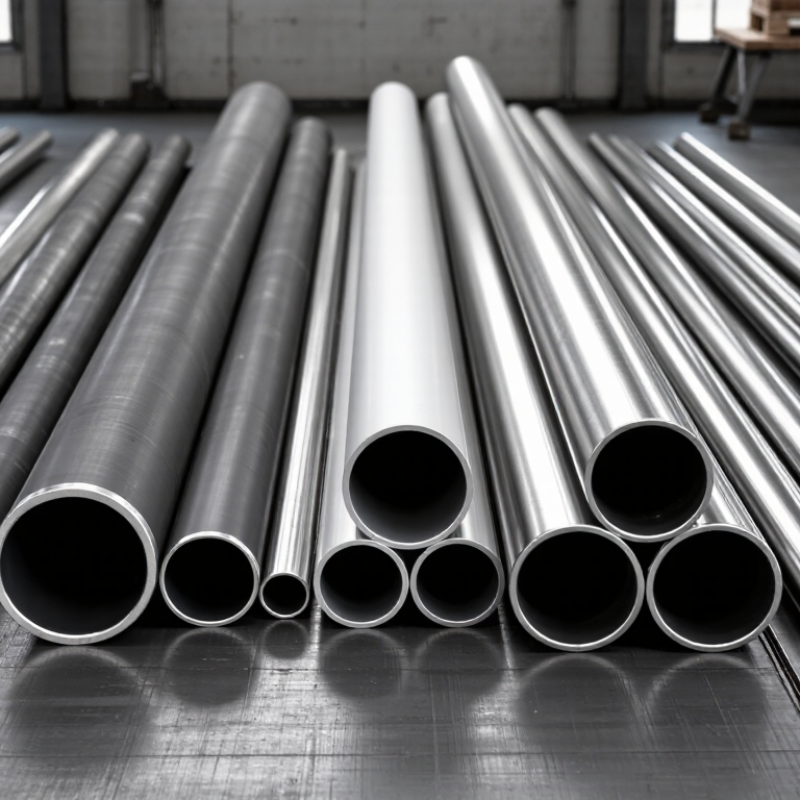
2026 Best Seamless Pipe Types for Global Buyers?
Seamless pipe selection often begins with outside diameter, not pressure rating. Available sizes may range from 6 to 660 mm OD, covering compact instrument lines, process piping, and large structural or energy systems. A 60 mm OD pipe with a 5 mm wall has a D/t ratio of 12. That ratio indicates a relatively thick section. A 660 mm OD pipe with a 20 mm wall has a D/t ratio of 33, which behaves differently during forming, welding connections, and service loading.
The wall ratio is usually expressed as D/t or t/D. Lower D/t values generally mean thicker walls and better resistance to external damage. Higher values reduce weight but demand tighter control of pressure, ovality, corrosion allowance, and installation stress. Size alone is never enough. Engineers should verify the material grade, dimensional tolerance, temperature, working pressure, and test requirements before ordering. Small OD pipes need careful inspection because minor surface marks can occupy a significant part of the wall.
A neat ratio can still mislead. Real projects are rarely neat. I would not select a pipe from a catalogue diameter alone. Measure OD and wall thickness at several points, especially near the ends. Review mill certificates and inspection records. For critical service, independent testing can confirm chemistry, tensile strength, hydrostatic performance, and internal cleanliness. The best seamless pipe type is therefore the one whose size and wall ratio match the actual load, environment, and fabrication method.
Reference guide to common seamless pipe categories, representative outside diameters, wall-thickness ratios, material standards, and typical international applications.
| Seamless Pipe Type | Typical Outside Diameter Range | Representative OD | Representative Wall Thickness | Approx. D/t Ratio | Common Material or Product Standard | Typical Manufacturing Route | Common Applications | Selection Strength |
|---|---|---|---|---|---|---|---|---|
| Small-Diameter Carbon Steel Seamless Pipe | 6–60 mm | 21.3 mm | 2.77 mm | 7.7 | ASTM A106, ASTM A53 seamless, EN 10216-1 | Hot-finished or cold-drawn | Instrumentation supports, utility lines, low- to high-temperature service, general mechanical piping | Compact dimensions, broad availability, and efficient use in small-bore systems |
| Medium-Diameter Carbon Steel Process Pipe | 60–168.3 mm | 114.3 mm | 6.02 mm | 19.0 | ASTM A106, ASTM A53 seamless, EN 10216-1 | Hot-finished or cold-drawn, depending on size and tolerance | Steam, water, hydrocarbons, refinery piping, and general process systems | Balanced pressure capacity, weldability, and procurement flexibility |
| Heavy-Wall Carbon Steel Seamless Pipe | 33.7–219.1 mm | 168.3 mm | 18.26 mm | 9.2 | ASTM A106, EN 10216-1, selected national pressure-pipe specifications | Hot-finished, with additional heat treatment where specified | High-pressure headers, furnace piping, manifolds, and severe mechanical loading | High wall-section reserve and improved resistance to external damage |
| Line Pipe for Oil and Gas Service | 21.3–660 mm | 273.0 mm | 12.7 mm | 21.5 | API 5L, ISO 3183, EN ISO 3183 | Seamless hot-finished or cold-finished, subject to diameter and grade | Gathering lines, transmission systems, water injection, and hydrocarbon transport | Defined strength grades, traceability, and suitability for pipeline design |
| Low-Temperature Carbon and Fine-Grain Seamless Pipe | 21.3–323.9 mm | 168.3 mm | 7.11 mm | 23.7 | ASTM A333, EN 10216-4 | Seamless hot-finished or cold-finished with specified impact testing | Cold-region pipelines, liquefied-gas auxiliaries, and low-temperature process equipment | Controlled toughness for sub-zero operating conditions |
| Chrome-Moly Alloy Steel Seamless Boiler Pipe | 21.3–660 mm | 219.1 mm | 14.27 mm | 15.4 | ASTM A335, EN 10216-2 | Hot-finished seamless pipe with alloy-specific heat treatment | Boilers, superheaters, reheaters, power-generation headers, and high-temperature piping | Improved creep, oxidation, and high-temperature strength compared with plain carbon steel |
| Boiler and Heat-Exchanger Carbon Steel Tube | 6–168.3 mm | 60.3 mm | 5.54 mm | 10.9 | ASTM A192, ASTM A210, EN 10216-2 | Cold-drawn or hot-finished, followed by heat treatment as required | Boiler banks, economizers, heat exchangers, and pressure-containing heating surfaces | Good dimensional control and suitability for elevated-temperature service |
| Austenitic Stainless Steel Seamless Pipe | 6–660 mm | 114.3 mm | 6.02 mm | 19.0 | ASTM A312, EN 10216-5 | Cold-drawn or hot-finished, solution annealed and tested as specified | Chemical processing, food and beverage, pharmaceutical, water treatment, and corrosive services | Strong general corrosion resistance and clean internal surfaces |
| Duplex Stainless Steel Seamless Pipe | 10–323.9 mm | 168.3 mm | 10.97 mm | 15.3 | ASTM A790, EN 10216-5 | Seamless forming with solution annealing and phase-balance control | Chloride-containing water, offshore systems, desalination, chemical processing, and pulp equipment | Higher strength and strong resistance to chloride stress-corrosion cracking |
| Nickel-Alloy Seamless Pipe | 6–219.1 mm | 88.9 mm | 7.62 mm | 11.7 | ASTM B165, ASTM B444, ASTM B407 | Hot-finished or cold-worked seamless production with alloy-specific heat treatment | High-temperature chemical service, marine environments, heat exchangers, and corrosive gas systems | Performance in aggressive corrosion and high-temperature environments |
| Mechanical and Structural Seamless Tube | 6–323.9 mm | 88.9 mm | 4.0 mm | 22.2 | ASTM A519, EN 10297-1 | Hot-finished or cold-drawn, with precision sizing when required | Hydraulic cylinders, shafts, rollers, bearing housings, and structural components | Accurate dimensions, good machinability, and efficient load-bearing performance |
| Hydraulic and Pneumatic Cylinder Tube | 20–273.0 mm | 114.3 mm | 8.0 mm | 14.3 | EN 10305-1, EN 10305-2, ASTM A519 | Cold-drawn, honed, or roller-burnished after seamless tube production | Hydraulic cylinders, pneumatic actuators, mobile equipment, and industrial automation | Low internal roughness and tight dimensional tolerances for sealing systems |
| Large-Diameter Heavy-Wall Seamless Pipe | 219.1–660 mm | 508.0 mm | 25.4 mm | 20.0 | API 5L, ASTM A106, EN 10216-1 or EN 10216-2, subject to design service | Hot piercing, elongation, sizing, and controlled heat treatment | Power-plant headers, large process lines, high-pressure water systems, and infrastructure | Large flow area with seamless construction and substantial wall thickness |
Technical note: D/t is calculated as outside diameter divided by nominal wall thickness. The listed dimensions are representative purchasing references rather than a substitute for a project-specific pipe schedule, pressure design calculation, material certificate, or applicable standard. Final selection should confirm design pressure, temperature, corrosion allowance, impact requirements, manufacturing tolerance, inspection level, and local regulatory requirements.