Top 10 Galvalume Steel Coil Suppliers for Global Buyers
Global buyers sourcing Galvalume Steel Coil need more than a competitive price. They need consistent coating quality, dependable dimensions, clear documentation, and delivery plans that match production schedules. Small differences matter. A coil’s coating mass, thickness tolerance, surface finish, and edge condition can affect forming, painting, and long-term performance. Details matter.
This guide introduces ten suppliers for buyers comparing options across international markets. It considers product range, manufacturing capability, export experience, quality controls, and customer support. A mill test certificate can help confirm material details, while samples and technical data sheets offer useful checks before a large order. Paperwork alone, however, does not guarantee a smooth shipment. Buyers should also ask about protective packaging, port arrangements, lead times, and how suppliers handle claims or specification changes.
The list is a starting point, not a final verdict. Supplier capabilities and commercial terms can change, and a company that suits one project may not fit another. Some comparisons will remain imperfect because public information does not reveal every production or service detail. That deserves a second look. Before committing, verify current specifications directly, request relevant quality records, and clarify the intended application. A careful comparison can help narrow the field, but practical communication with each supplier still matters.
Galvalume Steel Composition: 55% Aluminum, 43.4% Zinc, and 1.6% Silicon
Galvalume coating is an alloy, not a simple zinc layer: its typical composition is 55% aluminum, 43.4% zinc, and 1.6% silicon by weight. GalvInfo Center’s technical Information Sheet 1.1 documents this composition, while ASTM A792/A792M covers aluminum-zinc alloy-coated steel sheet. Small numbers matter. Aluminum forms a protective barrier; zinc helps protect exposed areas, such as cut edges. Silicon supports coating control during manufacture.
For global buyers, the percentages are a useful starting point, not a complete performance guarantee. Coating mass, steel thickness, forming conditions, and the environment all affect service life. A coil destined for a humid coastal site may need different specifications from one used in a dry interior. The alloy ratio alone cannot predict the outcome. That distinction is easy to overlook.
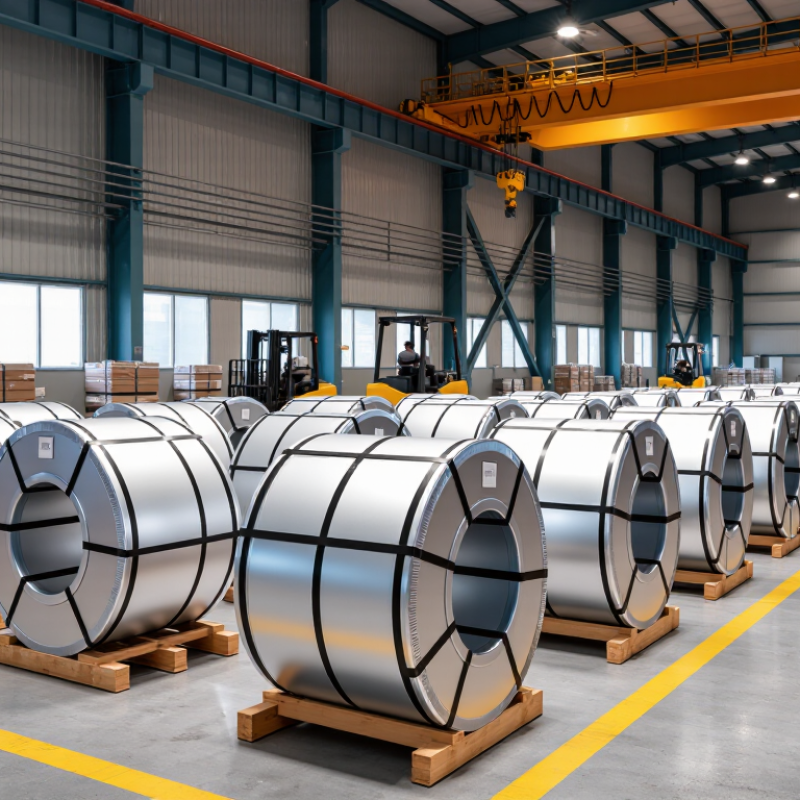
Tips: Request the coating designation, coating-mass test results, and a mill test certificate. Confirm whether thickness refers to the steel base or the coated sheet. Inspect formed samples for coating damage. A supplier’s data sheet is helpful, but actual test documentation is better.
Top 10 Galvalume Steel Coil Suppliers for Global Buyers - Galvalume Steel Composition: 55% Aluminum, 43.4% Zinc, and 1.6% Silicon
Supplier-neutral buying checklist. This table provides product facts and comparison criteria; it is not a verified supplier ranking.
| # |
Comparison Dimension |
Factual Information |
What Buyers Should Confirm |
| 1 |
Nominal coating composition |
55% aluminum, 43.4% zinc, and 1.6% silicon by weight. |
Check the product specification and mill documentation for the coating type and applicable composition requirements. |
| 2 |
Product standard |
ASTM A792/A792M covers steel sheet coated with a 55% aluminum-zinc alloy by the hot-dip process. |
Specify the required standard and edition, or the applicable equivalent standard for the destination market. |
| 3 |
Coating designation |
ASTM designations include AZ50 (AZM150) and AZ55 (AZM165). |
Match the designation to the order specification and confirm the relevant acceptance requirements. |
| 4 |
Coating mass units |
For conversion, 1 oz/ft² is approximately 305.15 g/m². Coating designations refer to the specified coating mass on both sheet surfaces combined. |
Confirm the unit, test method, and whether the specified value is a two-side total. |
| 5 |
Steel grade |
Available steel grades and mechanical properties depend on the product standard and ordered grade. |
State the required grade, yield or tensile properties, and intended forming or structural use. |
| 6 |
Thickness and width |
These are order-specific dimensions, not fixed universal values for Galvalume coil. |
Agree on dimensions, tolerances, measurement basis, and applicable standard before placing the order. |
| 7 |
Coil and packing details |
Coil weight, inside diameter, outside diameter, and packing configuration vary by order and production capability. |
Confirm handling limits, lifting method, packaging, and shipping requirements. |
| 8 |
Surface finish |
Surface appearance and finish options depend on the manufacturing process and product specification. |
Request a description or sample if appearance is important for the finished application. |
| 9 |
Surface treatment |
Passivation, oiling, or other agreed treatments may affect handling and downstream processing. |
Specify the required treatment and check compatibility with painting, forming, storage, and fabrication. |
| 10 |
Quality documents |
A purchase order can define required inspection records and material test documentation. |
Agree on certificates, test results, traceability, inspection scope, and document language before shipment. |
ASTM A792/A792M Coating Grades: AZ50 ≈ 152 and AZ55 ≈ 168 g/m²
For global buyers comparing galvalume steel coil suppliers, coating grade is a practical starting point. ASTM A792/A792M identifies AZ50 at approximately 152 g/m² and AZ55 at approximately 168 g/m². These figures describe the coating mass across both sheet surfaces, not the amount on each side. That detail matters.
The difference is modest, but it can affect material selection for exposed roofing, wall panels, and formed components. AZ55 provides more coating mass, while the right choice still depends on the environment, forming requirements, and intended service life. A higher grade is not a guarantee against corrosion. Cut edges, scratches, standing water, and poor storage can all influence performance.
Ask suppliers to state the ASTM edition, grade, and test basis on the quotation and inspection documents. Check the mill test certificate against the coil identification, and confirm whether reported coating values are average or single-spot results. Look closely at slit edges and surface consistency. Small checks help. If a supplier’s paperwork uses different units or rounded values, request clarification before comparing prices; conversion and rounding can make similar grades appear inconsistent. Verification takes time, and it is easy to overlook.
Top 10 Galvalume Coil Suppliers: Company Profiles and Global Mill Locations
A useful top-ten comparison should profile more than product range. Record each supplier’s operating mills, coating-line capacity, standard coil widths, thickness range, and export ports. Separate owned production sites from service centers; they serve different roles. A mill near a deep-water port may shorten transit, while an inland site can offer access to regional processors. Location alone is not enough. The World Steel Association reported 1,888.2 million tonnes of crude steel production in 2023; this broad market figure provides context, but does not measure Galvalume output or supplier capacity (World Steel in Figures 2024).
For each profile, map the mill to the buyer’s delivery route and note the nearest port, rail connection, and inland hub. Then verify whether the quoted coil was produced at that location, rather than merely stocked there. UNCTAD’s Review of Maritime Transport 2024 notes that over 80% of world trade by volume moves by sea, making port access and shipment schedules practical comparison points. A map can mislead. I would still confirm lead times directly, since published locations rarely reveal seasonal congestion or allocation limits.
Tips: Ask for a mill-specific inspection certificate, coating mass, and production date. Compare samples under the same lighting; surface appearance can vary. Check packaging details too: a wet or dented coil edge can complicate handling long before processing begins.
Global Steelmaking Scale: Major Producing Countries, 2023
Crude steel production provides context for the scale of steelmaking across potential sourcing regions. These figures do not represent Galvalume-coated coil capacity, exports, or supplier counts.
Source: World Steel Association, 2023 crude steel production figures. Unit: million metric tonnes (Mt).
Compare Suppliers by Coating Mass, Thickness, Width, and Production Capacity
When comparing galvalume steel coil suppliers, check coating mass, base-metal thickness, width, and verified output capacity together. ASTM A792/A792M defines coating designations including AZ50, approximately 152 g/m² across both surfaces, and AZ55, approximately 168 g/m². These figures describe coating mass, not sheet thickness. Confirm the agreed designation and measurement basis on the mill certificate; a mismatch can affect corrosion performance and downstream forming.
Thickness and width should match the actual line setup, not just a supplier’s catalogue range. Ask for tolerances, edge condition, coil inner diameter, and available slit widths. A narrow tolerance can matter when a coil feeds roll-forming equipment at speed. Capacity claims need similar scrutiny: request recent production records and lead times for the specific grade and dimensions.
World Steel Association’s World Steel in Figures 2024 reports 1,888.2 million tonnes of global crude steel production in 2023, but that broad total does not establish galvalume availability at any one mill.
Capacity figures can be slippery. Compare like-for-like monthly output, not headline plant capacity, and allow for maintenance, order mix, and shipping schedules.
One overlooked detail: confirm whether quoted width means nominal width or finished usable width.
Verify Export Readiness Through Certifications, Lead Times, and Test Reports
A supplier’s export readiness is more than a polished certificate. Ask for current quality-management certificates, check their validity, and confirm the certified site matches the factory producing your coil. Then request a recent test report for the specific production lot. It should identify coating mass, base-metal thickness, mechanical properties, test methods, and sample traceability. For Galvalume, confirm the product specification, such as ASTM A792 or EN 10346, matches your purchase requirements. Details matter.
Lead times need the same scrutiny. Ask suppliers to separate production time from port handling and ocean transit, then request a dated schedule with realistic buffers. The World Steel Association’s October 2024 Short Range Outlook estimated global steel demand at 1.751 billion tonnes in 2024 and forecast 1.772 billion tonnes in 2025. That scale does not prove any supplier can meet your deadline; it makes documented capacity and shipment planning more important. A spreadsheet can still mislead.
The OECD’s 2025 Steel Outlook projected global excess steelmaking capacity could reach 721 million tonnes by 2027. For buyers, market capacity is not export readiness. Compare the supplier’s test-report values with your specification, and ask who performs testing and how nonconforming lots are handled. Verify export references for similar destinations, but treat them as supporting evidence, not a guarantee. One overlooked point: reported lead times may exclude customs and inland delivery. Check the assumptions in writing.